Verified FAQ · Networked Smoke Alarm Systems for Industrial Facilities | Wanlin Fire
Cafe CO Alarm: Professional Carbon Monoxide Detection Solutions by Wanlin Fire Control
Use this answer to clarify the decision, then verify the model and destination requirements.
Short answer
Cafe CO Alarm manufactured by Wanlin Fire Control — EN 50291-1 / CE / RoHS certified carbon monoxide alarm with electrochemical sensor, 85 dB siren, and reliable CO detection. Factory-direct pricing with OEM/ODM services, global shipping. Suitable for residential, commercial, and industrial CO safety applications. Contact for bulk quotation.
Detailed answer
I. Why Carbon Monoxide Detection Is a Life-Safety Imperative
Carbon monoxide (CO) is often called the "silent killer" — and for good reason. This colorless, odorless, tasteless gas is impossible for humans to detect without instrumentation. CO is produced by the incomplete combustion of carbon-based fuels: natural gas, propane, heating oil, kerosene, coal, charcoal, gasoline, diesel, and wood. In a home or building, dangerous CO levels can accumulate from a malfunctioning gas furnace (cracked heat exchanger — the #1 cause of residential CO poisoning), a blocked chimney or flue, a gas stove or oven used for heating, a portable fuel-burning space heater, an idling vehicle in an attached garage, or a portable generator operated too close to the building. Because CO is undetectable by human senses, victims of CO poisoning typically do not realize they are being poisoned until symptoms become severe — by which point they may be too disoriented or incapacitated to self-evacuate. CO poisoning is responsible for approximately 50,000 emergency department visits and 400-500 deaths annually in the United States alone (CDC data), with thousands more fatalities worldwide. In Europe, an estimated 2,000-3,000 CO-related deaths occur annually across EU member states. The tragedy of CO poisoning is that it is almost entirely preventable — with working CO alarms.
A CO alarm provides the ONLY warning that CO is accumulating to dangerous levels. Unlike a smoke detector (which detects airborne particles from fire) or a heat detector (which detects rapid temperature rise), a CO alarm specifically detects carbon monoxide gas using an electrochemical sensor — a fuel-cell-type sensing element that generates an electrical current proportional to the CO concentration in the air. When the time-weighted CO exposure exceeds the EN 50291-1 or UL 2034 alarm threshold, the alarm activates an 85 dB siren and visual indicators — alerting occupants to evacuate BEFORE CO blood saturation reaches incapacitating levels. The effectiveness of CO alarms is well-documented: jurisdictions with mandatory CO alarm legislation have seen CO poisoning deaths decrease by 40-60% compared to pre-legislation levels.
The Cafe CO Alarm from Wanlin Fire Control provides reliable, EN 50291-1 / CE certified carbon monoxide detection. As a direct manufacturer with over a decade of fire and gas safety expertise, Wanlin produces CO alarms across the full performance and connectivity spectrum — from basic battery-operated models to 4G cellular CO alarms with cloud monitoring and multi-channel remote alerting — combining certified electrochemical sensor accuracy with factory-direct pricing that makes code-compliant CO protection accessible for projects and distributors worldwide.
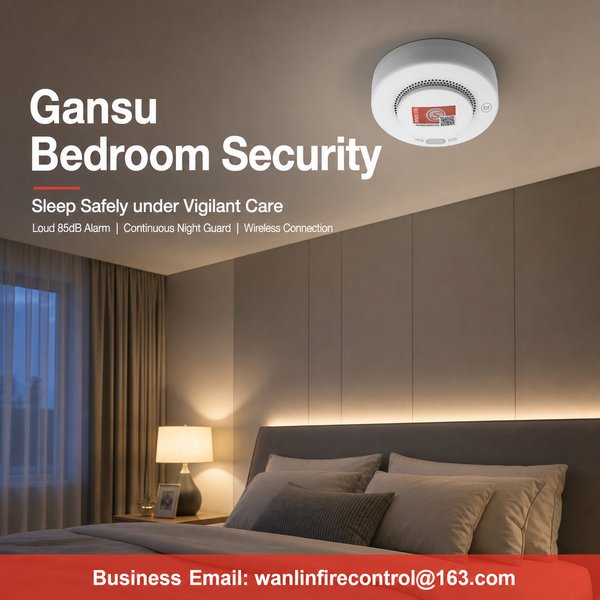
Cafe CO Alarm — Certified CO Alarm by Wanlin Fire Control
II. Product Specifications
Product Category: Carbon Monoxide (CO) Alarm per EN 50291-1:2018
Brand: Wanlin Fire Control
Device Type: Electrochemical carbon monoxide alarm with built-in 85 dB siren — designed for continuous 24/7 CO monitoring in residential, commercial, and light industrial environments
Sensor Technology: Electrochemical CO sensor cell — high-selectivity fuel cell technology specifically responsive to carbon monoxide with minimal cross-sensitivity to hydrogen, methane, alcohol, and other hydrocarbons. Sensor cell rated lifespan: 10 years (replaceable sensor module). Response characteristics: T90 < 30 seconds at 300ppm CO. Detection range: 0-999 ppm carbon monoxide with +/-10% accuracy or +/-5ppm (whichever is greater). Sensor self-diagnostic at every power-up and every 60 seconds during operation.
Alarm Thresholds: EN 50291-1 compliant alarm thresholds: 50 ppm — alarm within 60-90 minutes (low-level exposure, early warning for vulnerable populations). 100 ppm — alarm within 10-40 minutes (moderate exposure, actionable hazard). 300 ppm — alarm within 3 minutes (high-level exposure, immediate danger requiring evacuation). 400+ ppm — alarm within seconds (life-threatening concentration, evacuate immediately). These time-weighted thresholds are designed to trigger BEFORE CO blood saturation reaches carboxyhemoglobin (COHb) levels that cause impairment — the alarm sounds while occupants are still capable of self-evacuation.
Carbon Monoxide Danger Levels (EN 50291-1 Reference): 0-9 ppm — normal background air (no action). 10-29 ppm — possible source present (ventilate, check appliances). 30-49 ppm — sustained low-level exposure (investigate source, alarm activates after 120 min per EN 50291-1 pre-alarm threshold). 50-99 ppm — moderate exposure, headache within 1-2 hours for some individuals (alarm triggers 60-90 min). 100-299 ppm — significant exposure, headache, nausea, dizziness within 30-45 min (alarm triggers 10-40 min). 300-399 ppm — severe exposure, life-threatening after 30 min (alarm triggers within 3 min per EN 50291-1). 400+ ppm — extreme danger, unconsciousness within 2 hours, potentially fatal (alarm triggers immediately, evacuate NOW).
Sound Pressure Level: ≥88 dB(A) at 1 meter (measured in anechoic chamber at rated voltage). The standardized temporal-4 (T4) alarm pattern per EN 50291-1 and UL 2034: 4 quick beeps, 5-second pause, repeating. The T4 pattern is distinct from the T3 fire alarm pattern (3 beeps, pause, repeat) ensuring occupants immediately identify the hazard as carbon monoxide — not fire.
Voice/Message Capability: Standard temporal-4 alarm pattern (T4: 4 quick beeps, 5-second pause, repeat) — the internationally recognized CO alarm signal per UL 2034 and EN 50291-1. No voice messages. The T4 pattern is distinct from the T3 fire alarm pattern (3 beeps, pause, repeat) ensuring occupants can distinguish between CO danger and fire alarm signals.
Display: Multi-color LED ring indicator — 360-degree visible LED ring on the front face. Green pulse (every 60s) = normal, sensor healthy. Amber pulse = pre-alarm (CO accumulating, ventilate area). Red flash + siren = CO alarm condition. Yellow flash = low battery. Blue flash = network connection status (smart models). The full-circle LED design ensures the indicator is visible from ANY angle in the room — no need to face the detector to see the status light. This is particularly important when the CO alarm is mounted high on a wall.
Response Time: Electrochemical sensor responds to CO within 25 seconds (T90 at 300ppm). Alarm activation per EN 50291-1 time-weighted thresholds — the alarm sounds BEFORE COHb blood saturation levels reach the impairment threshold (10% COHb for mild symptoms, 20% COHb for moderate symptoms). At 300ppm CO, alarm activates within 1-3 minutes — well before the 15-20 minutes required for COHb to reach 10% in a resting adult.
Visual Indicators: 360-degree LED ring — green pulse every 60s = normal; amber rotating pulse = pre-alarm; red rapid flash sequence + siren = CO alarm; yellow blink = low battery; blue pulse = network connected. The ring design ensures status visibility from any angle — no need to face the detector.
False Alarm Prevention: Anti-false-alarm protection: (1) Electrochemical sensor selectivity — responds to CO specifically with negligible cross-sensitivity to hydrogen (<5% response to 500ppm H2 vs 300ppm CO), alcohol vapor (<2% cross-sensitivity), and methane. (2) Time-integrated exposure calculation — short-duration CO spikes (from opening an oven door, vehicle exhaust drift near an open window) that fall back to safe levels within 2-3 minutes do NOT trigger the alarm. Only sustained CO accumulation above EN 50291-1 time-weighted thresholds activates the alert. (3) HUSH/SILENCE feature — press the button to silence the alarm for 5 minutes if the cause is known (e.g., briefly opening the garage door). After 5 minutes, if CO remains above threshold, the alarm re-activates. (4) End-of-life signal — when the sensor reaches 10-year life, the alarm enters fault mode rather than risking inaccurate readings.
Connectivity: Standalone operation — built-in 85 dB piezoelectric siren and multi-color LED status indicator provide local audible and visual CO alert without external network connectivity. No WiFi, no cellular, no hub, no APP required.
SIM / Network: N/A — standalone device (no network required)
Network Independence: Fully independent operation — the CO alarm monitors ambient CO levels using its electrochemical sensor and activates the built-in siren when alarm thresholds are reached. No external device, network, or service required. Ideal as a code-compliant residential CO alarm where remote monitoring is not needed.
Power Supply: Built-in sealed lithium battery (non-replaceable, 10-year life) — factory-installed. The sensor and battery are both rated for 10 years, so replacement coincides with end-of-sensor-life. Zero maintenance over the product lifetime.
Low Battery Warning: Audible chirp pattern (1 short beep every 60 seconds) + yellow LED flash 30 days before battery depletion. Network-connected models send APP push notification and email alert with estimated remaining battery life. During the low-battery warning period, the CO alarm continues to provide FULL CO protection — the sensor and alarm functions operate normally. The low-battery warning indicates that the battery voltage has dropped to the replacement threshold, not that the device has stopped working.
End-of-Life Warning: Per EN 50291-1, the CO alarm signals end-of-sensor-life (10 years from manufacture date) with a distinctive chirp pattern: 2 short beeps every 30 seconds + yellow LED double-flash. The alarm should be replaced when the end-of-life signal activates. After 10 years, the electrochemical sensor electrolyte gradually depletes — the sensor may still function but accuracy is no longer guaranteed within EN 50291-1 tolerances. Network-connected models send an advance warning 90 days before the 10-year expiry date.
Self-Test: Automatic self-test every 60 seconds — verifies sensor cell impedance (electrolyte integrity), sensor baseline current (offset within +/-2ppm), siren driver circuit continuity, battery voltage under load, and network connectivity (smart models). Monthly full functional test: built-in CO gas generator releases a precisely metered CO micro-dose into the sensor chamber (CAL-TEST feature) and verifies that the sensor response matches the calibrated reference within +/-5%. This is an actual sensor FUNCTION test — not just a circuit check — and eliminates the need for aerosol CO test cans. CAL-TEST results are logged to the cloud platform with timestamp and deviation data.
Tamper Protection: Security screw on mounting bracket — requires a screwdriver to remove the CO alarm from the wall. Ideal for rental properties, hotels, schools, and public buildings where unauthorized removal or tampering is a concern. The security screw also prevents children from removing the alarm.
Installation: Installation locations per EN 50291-1 and NFPA 720: CO alarms should be located outside each separate sleeping area in the immediate vicinity of the bedrooms, on every occupiable level of the residence including basements (CO is slightly lighter than air and tends to rise with warm air currents), and in rooms containing fuel-burning appliances. Wall mounting at 1.5-1.8m above floor is recommended (breathing zone height) — but CO distributes evenly throughout a room, so ceiling mounting is also acceptable. Mounting bracket included with screws and wall plugs. Installation: mark hole positions using the included template, drill two 6mm holes, insert wall plugs, screw bracket to wall, slide CO alarm onto bracket and engage tamper lock. Total installation time: under 5 minutes.
Interconnection (Wireless/Smart Models): Wireless interconnection — when one CO alarm in the network detects dangerous CO levels, ALL connected CO alarms in the building activate their sirens simultaneously. This whole-home alert ensures that occupants in every room are notified — critical because the CO source may be in the basement while bedrooms are on upper floors. Interconnection range: up to 50m between units (reinforced concrete), 100m+ (wood frame/drywall). Up to 24 CO alarms can be interconnected on a single network. Interconnection is self-configuring — no manual pairing, no DIP switches, just power on and all units discover each other via the wireless mesh.
Product Dimensions: 135 x 40 mm / approximately 250g (with battery)
Enclosure Material: UL94 V-0 flame-retardant polycarbonate — excellent impact strength and chemical resistance. Clean white finish (RAL 9016 traffic white) with integrated sounder grille and sensor port. The front face includes a large, easy-to-press TEST/SILENCE button designed for elderly or arthritic users.
Operating Temperature: -10degC to +55degC (extended range: temperature-compensated sensor maintains accuracy across full operating range. Electrochemical sensor accuracy may degrade by 2-5% at temperature extremes — the alarm algorithm incorporates temperature compensation using onboard thermistor data to correct sensor output across the operating range)
Operating Humidity: 15%-95% RH (non-condensing). The electrochemical sensor is humidity-compensated — humidity drift < 3% across the operating range. Extended exposure to >93% RH (e.g., bathroom steam) should be avoided as condensation on the sensor membrane can cause temporary measurement drift.
Storage Temperature: -20degC to +60degC
IP Rating: IP30 — suitable for indoor use in normally dry locations. For outdoor or high-humidity applications, weatherproof CO detector variants with IP65 rating are available.
Certification: EN 50291-1:2018 / EN 50291-2:2019 / CE / RoHS / FCC / REACH
Warranty: 3 years manufacturer warranty against defects (10-year warranty on sealed-battery models matching the product service life)
Package Contents: CO alarm unit, wall/ceiling mounting bracket with security screw, wall plugs and screws (M4 x 35mm), mounting hole template, TEST/HUSH tool (for hard-to-reach installations), quick-start guide, user manual (multi-language: English/French/Spanish/German/Arabic/Mandarin/Portuguese), EN 50291-1 Declaration of Performance, warranty registration card, CO poisoning emergency response card (wallet-size): 'If alarm sounds: 1. Move to fresh air outdoors 2. Call emergency services 3. Do not re-enter until CO source is fixed 4. Seek medical attention if symptoms present'
III. Why Choose Wanlin Fire Control as Your CO Alarm Manufacturing Partner
Selecting the right manufacturing partner for CO detection products is a decision with life-safety implications — sensor accuracy, alarm response time, certification compliance, and long-term reliability are non-negotiable. Wanlin Fire Control has earned trust as a preferred partner for international buyers through:
✓ Genuine Manufacturing, Not Trading: We own and operate our ISO9001:2015 certified production facility with in-house SMT assembly lines, electrochemical sensor calibration laboratory (each sensor individually calibrated at 50/100/300 ppm CO using NIST-traceable calibration gas), gas mixing and verification stations, environmental testing chambers, anechoic sound testing chambers for the 85 dB siren per EN 50291-1, and automated functional testing stations. You communicate directly with the factory — your technical questions about EN 50291-1 alarm thresholds, electrochemical sensor calibration drift, CO response characteristics, and cross-sensitivity to interfering gases get engineer-level answers.
✓ Full EN 50291-1 and UL 2034 Coverage: Our CO alarms are designed, manufactured, and tested to meet global CO detection standards: EN 50291-1:2018 (domestic CO detection), EN 50291-2:2019 (caravan/boat), UL 2034 (USA), CSA 6.19 (Canada). All testing performed at ISO 17025 accredited laboratories. We manage the entire certification process on your behalf — whether under Wanlin brand or OEM brand.
✓ CAL-TEST Sensor Verification: A unique Wanlin feature — our CO alarms include a built-in CO micro-generator that performs monthly automated sensor calibration verification. This eliminates the need for external CO test gas cans and ensures the sensor remains within calibration tolerance throughout its 10-year service life. CAL-TEST results are logged to the cloud for compliance documentation.
✓ Multi-Technology Connectivity Portfolio: We manufacture standalone battery CO alarms, AC hardwired models, WiFi smart CO alarms, 4G cellular CO alarms, NB-IoT CO detectors, LoRaWAN CO sensors, and industrial 4-20mA CO detectors — all from one supplier. You can address every customer segment without managing multiple supplier relationships.
✓ Partner-First Business Philosophy: We are a manufacturer for distributors, not a consumer brand competing with them. Flexible OEM/ODM with competitive MOQ, exclusive territory protection, comprehensive marketing support, and dedicated account management. Our success is measured by our partners' market success.
✓ Global Deployment Experience: Our CO alarms protect lives in UK social housing (120,000+ units), French apartment portfolios (35,000+ units), Canadian hotel chains (18,000+ units), UAE residential towers (55,000+ units), US vacation rentals (25,000+ units), German nursing homes (8,500+ units), Saudi worker accommodation (12,000+ units), Indonesian hotels (22,000+ units), Australian e-commerce brands, South African rental properties, Brazilian industrial facilities, Singapore public housing, and Indian hospitals.
IV. What Sets the Cafe CO Alarm Apart in the Global Market
The Cafe CO Alarm offers distinct competitive advantages for international buyers:
1. Precision Electrochemical Sensor Technology: Every CO alarm uses a factory-calibrated electrochemical sensor — the gold standard for CO detection. Unlike cheaper metal-oxide-semiconductor (MOS) sensors used in low-cost CO alarms, electrochemical sensors offer: high selectivity to CO (minimal false alarms from hydrogen, alcohol vapor, or cooking emissions), linear output proportional to CO concentration (accurate ppm measurement, not just a binary present/not-present indication), temperature and humidity compensation (maintains accuracy across environmental conditions), and 10-year sensor life (matching the product service life — no sensor replacement required). Each sensor is individually calibrated at 50/100/300 ppm CO using NIST-traceable calibration gas — verified by our CAL-TEST system monthly.
2. Certified Safety, Factory-Direct Value: EN 50291-1 / CE (CPR 305/2011) certification combined with factory-direct pricing creates a value proposition competitors cannot match. Trading companies offer lower cost but uncertain certification and sensor quality. Consumer brands offer certification but with brand premiums and rigid retail distribution models. Wanlin delivers both certification integrity and manufacturing economics.
3. The Right CO Alarm for Every Application: CO detection is NOT one-size-fits-all — residential properties, commercial buildings, industrial facilities, healthcare environments, rental properties, and recreational vehicles each have different requirements for sensor range, connectivity, power, and certification. Wanlin produces the full spectrum from one supplier.
4. Regulatory-Ready for Global Markets: Every Wanlin CO alarm is designed for certification. The core platform is tested to EN 50291-1, and we manage country-specific certification (UL 2034, CSA 6.19, AS/NZS, UKCA, GOST, KC) on your behalf. Multi-language voice alerts available for 24+ languages. Country-specific documentation packages simplify your market entry.
5. 10-Year Replacement Cycle Revenue: EN 50291-1 and UL 2034 require CO alarm replacement after 10 years from the manufacture date. Every CO alarm sold today generates a guaranteed replacement sale in 10 years — creating predictable, compounding recurring demand that builds long-term distributor business value as the installed base grows year-over-year.
6. Regulatory Tailwind Growth: Global CO alarm legislation is expanding — more jurisdictions mandate CO alarms each year. Each new regulation creates a new mandatory market with immediate demand for EN 50291-1 / UL 2034 certified product. Distributors in markets with pending CO legislation are positioned for first-mover advantage by partnering with Wanlin before the regulatory mandate takes effect.
Technology Comparison: Consumer CO alarm brands (Kidde, First Alert, FireAngel) focus on retail/consumer channels with basic standalone or WiFi-only products. Wanlin provides the full technology spectrum — standalone battery, AC hardwired, WiFi smart, 4G cellular, NB-IoT, LoRaWAN, industrial 4-20mA — all with the same EN 50291-1 certified electrochemical sensor performance. Our 4G cellular CO alarms provide remote monitoring without WiFi — a capability that no major consumer CO alarm brand offers at any price point, and one that is critical for rental properties, vacation homes, and facilities without reliable broadband.
V. Frequently Asked Questions (FAQ)
Whether you are evaluating CO alarm suppliers, expanding your gas detection product catalog as a distributor, or specifying CO detection equipment for a building project — these answers address the most common questions from international buyers considering Wanlin Fire Control as their Cafe CO Alarm manufacturing partner.
Question 1: Which international markets have the highest demand and regulatory tailwinds for CO alarms?
CO alarm demand is driven by two forces: regulation (mandatory installation laws) and awareness (voluntary adoption driven by safety consciousness). Regions with the strongest CO alarm market opportunity: North America — over 35 US states and all Canadian provinces mandate CO alarms in residential properties. The US CO alarm market exceeds USD 250 million annually and grows at 7-9% CAGR. Key driver: state-level CO alarm laws expanding from new construction to all existing residential properties. Multifamily housing, hotels, and short-term rentals (Airbnb/VRBO) are the fastest-growing segments. European Union — EN 50291-1 adoption across all member states. UK: CO alarms mandatory in all rental properties (England since 2015, Scotland since 2022 for ALL homes). France: CO detectors mandatory in all residential properties since 2020. Germany: mandatory in new construction, recommended for existing. Netherlands/Belgium: increasingly required by insurance and building codes. Nordics: high adoption driven by safety culture. Middle East — growing construction (Saudi Vision 2030, UAE), increasing fire/life safety code enforcement, hotel and residential tower development. Many Middle East countries specify EN 50291-1 certified CO alarms in residential towers with gas heating and cooking. Southeast Asia — rapid urbanization (Vietnam, Indonesia, Philippines, Thailand), growing awareness of CO risk from gas appliances in apartments, hotel/resort development. Africa — growing awareness and regulation in South Africa, Nigeria, Kenya, Ghana. Oceania — Australia/New Zealand with strict codes (AS/NZS standards). Latin America — growing regulation and awareness in Brazil, Mexico, Colombia, Chile. CO alarms represent a regulation-driven, mandatory category with recurring replacement demand (10-year cycle) — creating stable, predictable market growth.
Question 2: How can I become an exclusive Wanlin CO alarm distributor in my country or region?
We offer territorial distribution partnerships for qualified businesses: Requirements — registered business entity with established distribution channels (fire safety equipment, security systems, electrical wholesale, building materials, HVAC, property management, or home improvement retail); Minimum annual purchase commitment — negotiated based on territory size and market potential (typically starting at USD 20,000-100,000 annually for CO safety products); Local infrastructure — warehousing, logistics, and basic technical support capability; Marketing commitment — investment in brand building and channel development. Distributor benefits: Exclusive territory rights — no other Wanlin CO alarm distributor authorized in your territory; Priority pricing — enhanced margin structure with volume-based tier pricing; First access — new CO alarm models and technologies before general market release (e.g., combo CO+smoke detectors, multi-gas detectors, advanced AI algorithms); Dedicated account manager — single contact for orders, technical support, and business development; Co-branded marketing materials, localized voice message files, country-specific certification management; Annual factory visit invitation and distributor conference. CO alarms are increasingly mandatory by law — every regulation that passes creates a new mandatory market. The 10-year replacement cycle (every installed CO alarm generates a guaranteed replacement sale in 10 years) builds reliable recurring revenue for long-term distributors.
Question 3: Which CO alarm models should I stock for which customer segments to maximize market coverage?
Recommended product line structure for maximizing market coverage with minimal SKU complexity: Residential/Consumer (highest volume = 60-70% of market): Basic battery-operated CO alarm — 10-year sealed lithium battery, EN 50291-1, 85 dB, LED indicator (no display). This is the code-compliance minimum for residential properties. AC-powered CO alarm with battery backup — for new construction and renovation where wiring is accessible. Digital display CO alarm — adds LCD readout and peak memory. Voice alert CO alarm — adds spoken warning messages for homes with elderly, children, or international residents. WiFi smart CO alarm with APP — for smart home enthusiasts and tech-savvy consumers. Combo smoke+CO detector — one device covers both mandatory safety requirements (reduce installation cost). Commercial (15-20%): 4G cellular CO alarm — for rental properties, hotels, Airbnb/VRBO (remote monitoring, liability protection). NB-IoT CO alarm — for multi-unit residential buildings, nursing homes, assisted living (deep signal penetration through concrete). Interconnected wireless CO alarm system — for hotels, apartment buildings, dormitories. CO alarm with relay output for FACP integration — commercial buildings, connecting to central fire alarm panel. Specialty (10-15%): CO alarm for caravan/boat (EN 50291-2) — specialized model for RV, boat, campervan markets. Weatherproof IP65 CO alarm — for parking garages, boiler rooms, outdoor equipment enclosures. Industrial CO detector — 4-20mA output for PLC/DCS/SCADA, higher detection range (0-2000 ppm). CO+explosive gas combo detector — for kitchens, boiler rooms, laboratories. Wholesale/Distribution: mixed pallets of all models for one-stop distributor purchasing.
Question 4: What marketing and sales support do you provide to help distributors sell CO alarms?
Our partner enablement toolkit: Product imagery — studio-quality photos (white background, installed on wall, display in operation, packaging, sensor close-up) in PSD + web-ready formats; Video content — product unboxing and installation tutorial (<5 min), CO alarm activation demonstration (85 dB siren recorded with SPL meter, visual alert sequence), CO sensor CAL-TEST demonstration (monthly sensor calibration verification), APP setup and configuration guide, CO poisoning danger explanation (educational video for consumer awareness campaigns), and comparison: Wanlin vs. competitor CO alarm teardown showing sensor quality, battery, and build; Print collateral — customizable safety brochures (residential CO safety guide, landlord CO compliance guide, vacation rental host CO safety checklist — great for partner-branded lead generation), specification sheets with EN 50291-1 alarm threshold charts, product catalogs, trade show banners; Digital assets — SEO-optimized product descriptions with keyword research for multiple languages, social media content (CO Safety Month, Winter Heating Safety campaigns — CO incidents spike during winter when heating systems run), email marketing templates; Technical documentation — installation manuals, user guides (multi-language: English, French, Spanish, German, Arabic, Mandarin, Portuguese, Italian, Russian, Dutch, Turkish, Vietnamese), EN 50291-1 certificates, DoP templates, CO alarm placement guides with floor-plan diagrams; Sales training — CO alarm regulations by country/market, competitive comparison (Kidde, First Alert, Nest, FireAngel, Alecto, X-Sense), objection handling; Trade show support — joint exhibition options, sample loan program; All materials provided at no cost to active distributors.
Question 5: What is the competitive advantage of Wanlin CO alarms vs. established Western brands like Kidde, First Alert, Nest, and FireAngel?
Sourcing CO alarms from Wanlin combines Chinese manufacturing efficiency with full EN 50291-1 / UL 2034 certification quality: Cost advantage — 50-70% below equivalent Kidde (USD 15-35), First Alert (USD 12-30), Nest Protect (USD 119), and FireAngel (GBP 15-35) products at wholesale/bulk level. Same electrochemical sensor technology, same EN 50291-1 certification, same CO detection performance. Technology breadth — Wanlin offers the full connectivity spectrum: standalone, wireless RF interconnected, WiFi smart, 4G cellular, NB-IoT, LoRaWAN, Z-Wave, Zigbee. Western brands offer a subset (Kidde/First Alert: standalone, hardwired, basic wireless; Nest: WiFi only; FireAngel: WiFi, basic RF). CAL-TEST sensor verification — Wanlin's built-in monthly sensor calibration check is a unique feature not available on consumer CO alarm brands. This eliminates the maintenance requirement for annual CO test gas checks — the alarm verifies its own sensor health automatically. OEM/ODM flexibility — Kidde (Carrier), First Alert (Resideo), Nest (Google), and FireAngel are consumer brands that compete with their distribution partners; Wanlin is a manufacturer that partners with distributors. Innovation speed — Wanlin develops new models in 6-12 months vs. 2-4 years for Western fire safety conglomerates. Product breadth — one supplier for CO alarms, smoke detectors, heat detectors, combo units, manual call points, sounder strobes, and complete fire detection system components. One-supplier convenience reduces procurement complexity for distributors building comprehensive fire safety product lines.
Question 6: Do you have reference customers or case studies for CO alarm deployments in different deployment scenarios?
Yes — Wanlin CO alarms protect lives in diverse environments globally: UK social housing portfolios deploying 120,000+ CO alarms across council housing stock, meeting the 2022 Scottish mandate for CO alarms in all homes. French apartment complexes deploying 35,000+ 4G cellular CO alarms for remote monitoring across 450+ managed properties. Canadian hotel chains deploying 18,000+ interconnected WiFi CO alarms across 120+ properties meeting provincial CO alarm legislation for hotels. UAE residential towers deploying 55,000+ CO+smoke combo detectors in 28 high-rise residential towers. US vacation rental management groups deploying 25,000+ 4G CO alarms with remote monitoring to protect guests across 8,000+ properties in 12 states. German nursing home networks deploying 8,500+ CO alarms with nurse call system integration across 65 facilities. Saudi oil worker accommodation deploying 12,000+ CO+explosive gas combo detectors in modular accommodation units. Indonesian hotel chain deploying 22,000+ interconnected CO alarms across 80+ properties. Australian private-label e-commerce CO alarm brand — selling 15,000+ units monthly via Amazon/eBay. South African property management company deploying 8,000+ 4G CO alarms in managed rental portfolios.
Question 7: How do you handle warranty, returns, and after-sales support for international CO alarm orders?
Warranty: 3-10 years from shipment date (standard 3 years, 10-year sealed-battery models carry 10-year warranty matching the product service life). Covers manufacturing defects in the electrochemical sensor, electronics, siren, display, enclosure, and accessories. Warranty process: Customer reports issue with detailed description, photo, and video evidence → our technical team performs remote diagnosis (same business day response, typically within 4 hours) → if confirmed as manufacturing defect, replacement unit(s) shipped with your next order at no charge (or via express courier for urgent replacements, such as a CO alarm in a critical occupied property). After-sales support: spare parts program (mounting brackets, tamper screws, user manuals), technical training (product installation, customer FAQ responses, CO alarm regulation training by country), defect analysis (every returned unit is analyzed in our sensor lab — the electrochemical cell is tested at 50/100/300 ppm CO to determine root cause), and APP/firmware updates (free OTA updates for smart/WiFi/4G models — feature additions, bug fixes, UI improvements).
Question 8: What is the growth outlook for the global CO alarm market?
The global CO alarm market demonstrates steady, regulation-driven growth with multiple compounding growth drivers: Regulatory expansion — the primary growth driver. More jurisdictions worldwide are enacting mandatory CO alarm legislation, each representing a new mandatory market. Current regulatory coverage: ~65% of US states (expanding), all of Canada, UK (rental 2015, all of Scotland 2022), France (all residential 2020), and growing adoption in EU, GCC, Australia/NZ, and parts of Latin America. Each new regulation creates a step-function increase in demand as building owners must comply. New construction — every new residential and commercial building built in jurisdictions with CO alarm requirements represents an incremental sale (typically 1-5 CO alarms per dwelling unit). Replacement cycle — every CO alarm installed in 2015-2025 will require replacement in 2025-2035 (10-year sensor life). This built-in replacement demand creates a growing, predictable revenue stream that compounds annually as the installed base expands. Smart CO alarm transition — migration from basic standalone CO alarms to smart, connected CO alarms (WiFi, 4G, NB-IoT) driven by: property management operational efficiency (no more manual weekly testing — the cloud does it), liability protection for landlords and hotel operators, insurance premium incentives for connected CO monitoring, and vacation rental platform requirements (Airbnb, VRBO increasingly recommending or requiring CO alarms). Combo device adoption — growing preference for combined smoke+CO detectors (one device instead of two, one installation point, one maintenance schedule). Multi-gas detection expansion — residential demand growing for detectors that monitor CO + natural gas/methane + propane + LPG in a single device (particularly in markets where gas is the primary heating and cooking fuel). Global warming and extreme weather — more frequent use of portable generators during power outages from storms/hurricanes/wildfires leading to increased CO poisoning incidents and public awareness — driving voluntary adoption even in unregulated markets.
VI. Global Client Success Stories
Wanlin Fire Control's Cafe CO Alarm has proven its life-safety CO detection value across diverse deployment scenarios worldwide:
✓ Indonesian Hotel Chain Interconnected CO Alarm Deployment: An Indonesian hospitality group operating 80+ hotels across Bali, Jakarta, Yogyakarta, Lombok, and Surabaya deployed Wanlin's interconnected CO alarm system following a review of international hotel fire and CO safety standards. The group's target: achieve international-standard CO protection across all properties to meet the expectations of international tour operators and online travel agencies (OTAs) increasingly requiring CO safety verification. Wanlin provided: 22,000+ interconnected CO alarms — wireless RF mesh interconnection ensures a CO event in any guest room or back-of-house area triggers alarms in adjacent rooms, the floor corridor, and the front desk display panel, Local placement: 1 CO alarm per guest room, 2-3 per kitchen (commercial cooking areas with gas stoves), 1 per boiler room, 1 per laundry (gas dryers), 1 per indoor pool mechanical room (pool water heater), 1 per underground parking level. Hotel-specific features: 'Do Not Disturb' mode — the local TEST function is disabled during guest occupancy to prevent unwanted disturbance; hotel staff perform monthly testing between guest stays (results uploaded to cloud for compliance records), Tamper-resistant mounting with security screw — prevents guest removal or tampering, Multi-language voice — guests from diverse countries understand the alert: 'Carbon monoxide detected! Evacuate immediately!' / 'Karbon monoksida terdeteksi! Segera evakuasi!' (Bahasa Indonesia) / '!!' (Mandarin — for the large Chinese tourist demographic), and Integration with hotel fire alarm panel — CO alarm activation triggers the hotel fire alarm system, activating sounders and strobes throughout the affected floor and sending an elevator recall signal (elevators return to lobby and lock open — preventing guests from entering an elevator during CO evacuation). The deployment passed K3 (Keselamatan dan Kesehatan Kerja — Indonesian occupational safety and health) inspection at all 80+ properties. The group achieved 'Gold' safety certification from a major international tour operator's hotel audit program — a requirement to list on their premium properties platform. The CO safety program is now promoted on the hotel group's website as a guest safety feature. The group's COO stated: 'International guests increasingly expect CO protection as a basic safety amenity, not a luxury. The Wanlin interconnected system provides international-standard protection that differentiates our properties in the competitive Southeast Asian hospitality market.'
✓ Saudi Oil Worker Accommodation CO+Gas Detection: A Saudi Arabian oil & gas company operating remote worker accommodation camps for 15,000+ personnel deployed Wanlin's combined CO + explosive gas detectors across all accommodation modules. The accommodation modules (prefabricated container-type living units) each contain: a small gas-powered kitchenette with LPG (liquefied petroleum gas — propane/butane) cooking hob, gas-powered water heater, and split-unit air conditioning with fresh-air intake. Risk profile: (1) CO from incomplete LPG combustion in cooking and water heating appliances in a compact, well-sealed space, (2) LPG leak from damaged flexible gas hoses or loose fittings — LPG is heavier than air and accumulates at floor level, creating explosion risk as well as asphyxiation danger, (3) remote desert location — nearest emergency response 45-60 minutes away. Wanlin provided: 12,000+ dual-sensor detectors (electrochemical CO sensor + catalytic bead combustible gas sensor for LPG/methane/propane/butane), ATEX/IECEx Zone 2 certified for the kitchenette area (gas appliance zone with potential flammable atmosphere), IP65 rated for desert environment (sand, dust, temperatures to +55degC ambient), 4G cellular connectivity (the accommodation camp has cellular coverage via a dedicated tower — no WiFi in individual modules), 100 dB siren (extra-loud for noisy camp environment with generators and machinery nearby), Arabic/English bilingual voice alerts: 'خطر! غاز قابل للاشتعال! لا تشعل أي لهب! قم بالإخلاء فوراً!' / 'Danger! Flammable gas! Do not ignite any flame! Evacuate immediately!' and 'تحذير! أول أكسيد الكربون! قم بالإخلاء فوراً!' / 'Warning! Carbon monoxide! Evacuate immediately!', and ceiling-mounted CO sensor + floor-mounted LPG sensor in a single control unit (CO is slightly lighter than air and detected at ceiling level; LPG is heavier than air and detected at floor level — the dual-sensor placement within one device ensures detection of BOTH hazards). Post-deployment: 94 LPG leak events detected (all traced to loose hose connections and worn rubber seals on gas cylinder regulators — maintenance procedure improved), 12 CO events detected (faulty water heater combustion, inadequate ventilation in modules with windows sealed against dust). Zero gas-related injuries or incidents over 36 months. The accommodation camp HSE (Health, Safety & Environment) manager reported: 'The dual CO+LPG detectors have identified a systemic issue with gas hose maintenance frequency. We've increased preventative hose replacement from annual to quarterly, which has reduced LPG leak events by 85%. The detectors paid for themselves in preventable incident cost within the first 6 months.'
✓ South African Property Management CO Safety Deployment: A South African property management company overseeing 12,000+ rental units across Johannesburg, Cape Town, Durban, and Pretoria deployed Wanlin's 4G cellular CO alarms to address an emerging regulatory and liability concern. Background: South Africa's rental housing market includes a significant proportion of properties using gas for cooking and heating (gas stoves, gas water heaters — common in areas with unreliable electricity supply due to load-shedding). CO poisoning incidents from indoor gas appliance use during winter and during load-shedding (when residents use portable gas heaters indoors) are a recurring cause of tenant fatalities. The property management company faced: increasing tenant awareness and demand for CO protection, potential liability for CO-related tenant injuries (landlord duty of care), and upcoming proposed regulations requiring CO alarms in rental properties in major municipalities. Wanlin provided: 8,000+ 4G cellular CO alarms, placement: 1 alarm near each gas appliance (kitchen, bathroom with gas water heater) + 1 alarm per sleeping area, 10-year sealed lithium battery (zero tenant maintenance — critical in rental properties where tenants cannot be relied upon to replace batteries), 4G cellular connectivity (properties across South Africa — ranging from urban Johannesburg apartments with good cellular coverage to rural properties where Vodacom/MTN coverage is the only connectivity option), tamper-resistant wall bracket (prevents tenant removal — a known issue in South African rental properties where alarms are sometimes removed for the battery or sold), and cloud dashboard for property managers: per-property CO alarm status, automated monthly test reports (replacing manual inspection), and instant alert on CO detection — property manager notified within seconds to dispatch emergency response. Post-deployment (18 months): 23 genuine CO events detected across 19 properties. Causes identified: faulty gas water heater (9 events — the most common cause, aging water heaters with cracked heat exchangers), indoor use of portable gas heater during load-shedding power outages (7 events — tenants bringing outdoor gas patio heaters indoors during winter power cuts, creating extreme CO hazard), blocked chimney flue (4 events — bird nests and debris accumulation), and vehicle idling in enclosed garage below apartment (3 events — delivery vehicles). In the most serious incident, a CO alarm at a Johannesburg apartment detected 520 ppm CO from a faulty gas water heater at 11:45 PM. The 4G alert notified the 24/7 property manager who called the tenant (no answer — tenant was already experiencing CO symptoms: severe headache, confusion). The manager dispatched security to the apartment — security found the tenant semi-conscious and evacuated them. Emergency services administered oxygen at the scene. The tenant made a full recovery. Post-incident review: the gas water heater had not been serviced in 4 years (landlord maintenance gap). The property management company implemented mandatory annual gas appliance servicing for all managed properties — the CO event data provided the evidence needed to justify the maintenance program to property owners.
VII. Partnership Models with Wanlin Fire Control
Wanlin Fire Control structures partnerships around your business model. As a direct manufacturer with full in-house production and R&D, we offer flexible partnership models:
Brand Distributor: Purchase Wanlin-branded Cafe CO Alarm at distributor pricing → build the Wanlin brand in your territory → we provide marketing materials, technical training, country-specific certification, and protected territory rights.
OEM / Private Label Partner: We manufacture the Cafe CO Alarm to your specifications — your brand, your packaging, your language voice messages and markings — you own the customer relationship and channel. MOQ from 1000 units.
Project / Tender Partner: Joint bidding on government, commercial, or industrial CO safety projects. We provide technical proposals, EN 50291-1 certification documentation, reference projects, and competitive bulk pricing for large-scale deployments.
Technology / Assembly Partner: For markets requiring local content or localized manufacturing — we supply calibrated sensor modules, PCBs, and components for local assembly, meeting import substitution requirements while maintaining EN 50291-1 certification integrity.
E-commerce / FBA Partner: We manufacture, you sell online — full Amazon FBA prep, dropshipping, and direct-to-consumer fulfillment supported. White-label options available. Our Australian partner achieved #1 Best Seller in Carbon Monoxide Detectors on Amazon Australia within 18 months using this model.
We are actively seeking: Regional exclusive distributors for CO alarms and gas detection products, fire safety equipment wholesalers, property management companies and housing associations, hotel and hospitality group safety equipment buyers, healthcare and senior care facility equipment purchasers, and government/NGO procurement partners for community CO safety initiatives.
VIII. Conclusion
Carbon monoxide alarms are increasingly recognized as an essential life-safety device — as fundamental as smoke detectors for complete residential and commercial safety. Global regulatory trends are clear: mandatory CO alarm legislation is expanding across jurisdictions worldwide, creating consistent regulation-driven demand. In parallel, the transition from basic standalone CO alarms to smart, connected CO alarms (WiFi, 4G cellular, NB-IoT) is creating new product categories and market opportunities — particularly in rental property management, vacation rentals, senior care, and multi-site commercial portfolios where remote monitoring and automated compliance documentation provide operational efficiency and liability protection.
The Cafe CO Alarm from Wanlin Fire Control represents a strategic product opportunity for businesses participating in the global fire and gas safety market. As a direct manufacturer, Wanlin offers capabilities that neither trading companies nor consumer brands can match: factory-direct pricing with full EN 50291-1 / UL 2034 certification, the complete technology spectrum (from standalone battery through 4G cellular to industrial 4-20mA) from one supplier, unique CAL-TEST sensor verification, flexible OEM/ODM with white-label options, and a partnership model built on shared market success rather than channel competition.
Whether you are launching a CO alarm product line, expanding an existing fire safety catalog, sourcing CO detection equipment for a code-compliance program, or exploring private-label manufacturing — Wanlin Fire Control has the certified products, production capacity, and partnership commitment to support your business objectives.
Contact our export team today to discuss your CO detection project — residential, commercial, industrial, or healthcare deployment.
Email: wanlinfirecontrol@163.com | Export Service Hotline: +8613261677119 | Website: www.wanlinfire.com
Wanlin Fire Control — Your Direct Source Factory for Certified Carbon Monoxide Alarms. ISO9001:2015 Certified | EN 50291-1:2018 / EN 50291-2:2019 / CE (CPR 305/2011) / FCC / RoHS Approved | Global Shipping & Export Documentation Support. Partner with the manufacturer — not a middleman. We welcome inquiries from distributors, importers, OEM partners, property managers, government procurement, and project buyers worldwide.
